English at Lernforum Chur

Showing posts with label Confusing Vocabulary. Show all posts

Saturday, January 16, 2021

Confusing words: say and tell

 Torrie Gruber     January 16, 2021     Confusing Vocabulary   

The verbs say and tell have similar meanings. They both mean "to communicate verbally with someone". But we often use them differently.

The simple way to think of say and tell is:

  • You say something
  • You tell someone something
You say somethingYou tell someone something
Ram said that he was tired.Ram told Jane that he was tired.
Anthony says you have a new job.Anthony tells me you have a new job.
Tara said: "I love you."Tara told John that she loved him.

Here are a few rules to help you.

Personal object
We usually follow tell with a personal object (the person that we are speaking to). We usually use say without a personal object:

  • She told me that she loved John.
  • She said that she loved John.
  • He told everybody that he had to leave.
  • He said that he had to leave.

Say "to someone"
With say, we sometimes use "to someone":

  • He said to me that he was tired.
  • Tara said to Ram that he had done very well.
  • Anthony said to her, "I hope you come soon."
  • "I'd like to sleep," she said to him quietly.
GIVE IT A GO HERE. Good luck.  Be sure tell us about it in class soon.

Credit: englischhilfen.de
Read More

Saturday, September 12, 2020

Have or have got? Confused?

 Torrie Gruber     September 12, 2020     Confusing Vocabulary, Level A2   

 click here and: 


Have got and have mean the same. Have got is more informal.                                                            We use have (got) here to refer to both verbs:  
I’ve got a terrible pain in my back.                                                                                                I have a terrible pain in my back. (more formal)

They haven’t got a car.                                                                                                                     They They don’t have a car. (more formal)

We use have (got) to talk about possession, relationships, characteristics and illnesses.                      In these contexts, it is not used in the continuous form.


She’s got two cats and a dog. She has two cats and a dog. 
Not: She is having got two cats and a dog.
Have you got a drill?  Do you have a drill? (more formal)

How many brothers have you got?
How many brothers do you have? (more formal)

 She’s got a new boyfriend.

 She has a new boyfriend. (more formal)

thank you English Grammar Today 
Read More

Friday, March 6, 2020

Adverbs of Quantity

 Heidi     March 06, 2020     Confusing Vocabulary, First Certificate, Vocabulary Building   


Imagine that adverbs of quantity didn’t exist. You’d have to go around everywhere saying an exact number if you wanted to make the person you were talking to understand the quantity you were talking about. It’s much more comfortable (and quicker) to say “I have a lot of pages left to read for class today” than “I have 367 pages left to read for class today!” Not to mention the fact that you’ll spend a lot less time counting.

The list of adverbs of quantity in English is quite long. But there are some that are more used than others. In this article, we’ll explain what adverbs of quantity are and how to use them. To make this grammar review even more complete, we’ll also give you some examples, tips, and practice exercises.


What Are Adverbs of Quantity? 

As their name implies, adverbs of quantity tell how much or how many of something there is. We’ll get more into the difference between those ideas soon. It’s important to remember that adverbs are used to describe verbs, adjectives, adverbs, or sentences. Also, adverbs generally end in -ly. 

Adverbs of quantity give the degree of something. Let’s look at an example. 

He ate chocolate cake. 

With that sentence, we just know that he ate cake. We don’t know to what degree he studied. That’s where the adverbs of quantity come in. 

He ate a lot of chocolate cake. 

He ate a little chocolate cake.


Countable and Uncountable Nouns 

Do you remember what countable and uncountable nouns are? Countable nouns are the names of objects, people, ideas, and so on that can be counted and, therefore, used with a number. These nouns have a plural form. 

For example: One computer, two computers, three computers 

Uncountable nouns are the names of materials, liquids, and other things that we see as a whole and not as separate objects. They have no plural form and, therefore, we can’t use them with numbers. 

For example: water, milk, work 

Knowing the difference between countable and uncountable nouns is very important when using adverbs of quantity because the adverb you choose will depend on if the noun is countable or uncountable.


How Much vs. How Many 

If you want to ask a question about the quantity of something, you need to use either how much or how many to start the sentence. The difference is easy, though! How much is only used with uncountable nouns while how many is only used with countable nouns. 

For example: 

How much money do you have? 

How much juice is in the fridge? 

How many apples do you want? 

How many CDs do you have?

Many is used with countable nouns to indicate a big number. In general, it’s also used in negative and interrogative sentences. 

For example: 

Do you have many international friends? 

There are not many movies I enjoy. 

Are there many people working at your company?


A Little vs. A Few 

Yet again, the choice between these adverbs is left to whether the noun is countable or uncountable. If you still have doubts, an online English course could clear up all of your doubts really quickly. In this case, a little is used with uncountable nouns to indicate small quantities. It’s used in both affirmative and negative sentences but not usually in questions. 

For example: 

There is a little milk in the coffee, but not much. 

Susanne only knows a little French. 

A few is used with countable nouns to indicate a small number. It’s also used in sentences that are both affirmative and negative but it’s not often found in questions.

For example:

I have a few sweets, would you like one?

There are a few problems with this program.


A Lot Of 

This adverb of quantity is in a world of its own. It can be used with countable nouns as well as with uncountable nouns. It’s generally used in affirmative sentences to indicate a big number or quantity. This is an adverb that you will definitely see a lot of! 

For example: 

There’s a lot of snow in the North Pole. 

It costs a lot of money to stay at this resort. 

There are a lot of tourists in the city centre today. 

There is a lot of sugar in this drink


For the original article please see abaenglish.com
Read More

Wednesday, March 4, 2020

People is or people are… is people singular or plural?

 Heidi     March 04, 2020     Confusing Vocabulary   
English can seem very simple sometimes. When we’re beginning to speak English, we tend to think that we only have to translate what we want to say word for word, in the same order, and all problems will be solved. Even though literal translations are acceptable and are also very useful for learning English, they’re not without their difficulties. In many cases, things are simply not said the same in both languages.

Now we’ve arrived at the point that concerns us today: should you say “people is” or “people are”? Keep the following in mind: in some languages, the word people is a singular, indeterminate group of humans. In English, that simply isn’t true. The word people in English is actually the plural of person. Persons can also be used sometimes.  


When do we say persons? 
To be able to understand the contexts in which you can use the word people and to use it correctly (and whether it’s followed by is or are), let’s start by quickly reviewing the use of person, persons, and people. Person is a singular noun. We use it to refer to any human being. 

Diana is a very emotional person. 

Even though it’s the plural of person, persons is rarely used. It’s considered very formal and is used mainly in legal contexts. 

Persons with a foreign passport must hold a visa. 

People is also the plural of person. It’s the word that most often used when referring to a group of people. 

The manager interviewed several people for the position.


So, how do I refer to a group of people? 
Well, don’t stress! If you’re translating from your native language, you can use the word people to signify a group of people. The important thing to remember is that the conjugation will always be people are. 

Look at these examples: 

People are always happy when Friday comes.

People are usually aware of the rules.

The same rule applies to the past. We say people were (plural) and never people was. 

The people were happy because it was a long weekend. 


Asking questions with people 
Keeping in mind what we’ve learned, you simply have to apply the same rules when forming questions. People is a countable noun. So, for example, if you wanted to ask about the number of people in a certain place, you would use how many. 

How many people are there in the house? 

There are four people in the house. 

To mention that there’s only one human being, you use person. 

There is one person in the class. 

Let’s look at some more examples: 

People are not visiting the mall lately. 

Were there any people in the swimming pool?


Formal language and nationalities 
As we mentioned, the ideal plural for person is people, since the expression persons is considered archaic. It’s a word that is widely used in legal documentation, though. 

Persons under 21 years of age are not allowed to access this place. 

Similarly, the word individuals is rarely used in spoken English and is restricted to official documents. 

I saw three individuals walking down Main Avenue. 

In the previous example, we might be testifying in court that we saw these individuals as part of a trial. It wouldn’t be something you would say in a casual conversation with friends. If we want to express the nationality of a group of people, we can use their nationality (German, American, Colombian) + people, or their country of origin: 

Italian people are very friendly. 

People from Africa are usually good dancers. 

We use peoples when talking about different ethnic groups or about the human race in general. 

The World Bank aims to promote indigenous peoples’ development.

Have you learned enough? Now, the next time someone asks you this question, you’ll know how to answer. Just remember that “people” and “a group of people” will always be people in English and that you should always conjugate it as a plural: PEOPLE ARE. English grammar poses a lot of challenges. In the end, these are something exciting and fun waiting to be discovered. 
Read More

Wednesday, February 19, 2020

Avoid mistakes using the correct worder

 Heidi     February 19, 2020     Confusing Vocabulary   

1. Sentences

correct word orderincorrect word ordertip
I was shopping in Leipzig.I was in Leipzig shopping.1
He played football yesterday.He played yesterday football .2
Yesterday he played football.
Dan rode his bike carefully.Dan rode carefully his bike.3
He often reads books.He reads often books.4a
He Is always late.He always is late.4b
tipBe careful!detailed explanation
1main verb before placeWord order: subject-verb-object-place-time
2place before expression of timeWord order: subject-verb-object-place-time
3object before adverb of mannerPosition of adverbs
4aadverb of frequency before main verbPosition of adverbs of frequency
4badverb of frequency after form of to bePosition of adverbs of frequency

2. Questions

correct word orderincorrect word ordertip
Do you play football or handball?Play you football or handball?5
When did you see Peggy yesterday?When did you yesterday see Peggy?6
tipBe careful!detailed explanation
5Start the question with the auxiliary do.Questions in the Simple Present
6Put the expression of time (yesterday) at the end of the question. Questions in the Simple Past
Read More

Monday, February 10, 2020

How to use the phrase the Internet correctly

 Heidi     February 10, 2020     Confusing Vocabulary   


Correct phraseCommon error
I'm on the Internet.I'm in the Internet.
I'm on the Net.
I surf the Internet.I surf in the Internet.
I surf the Net.
You'll find the information on the Internet.You'll find the information in the Internet.
In our hotel all rooms have access to the Internet.In our hotel all rooms have access to Internet.
I use the Internet.I use internet.
You can buy the book over the Internet.You can buy the book in the Internet.
I'm online. 
The word Internet is often written in capital letters.
Read More

Monday, February 3, 2020

How to use look forward to correctly

 Heidi     February 03, 2020     Confusing Vocabulary   
Sometimes the phrase ›look foward to‹ is not used correctly. We've listed some phrases which are wrong and some which are correct. 
Correct phraseCommon error
I'm looking forward to my holidays.I'm looking forward for my holidays.
I look forward to hearing from you.I look forward to hear from you.
We look forward to meeting them tonight.We look forward to meeting they tonight.
The word ›to‹ is a preposition, so it has to be followed by a noun phrase or a gerund.
Read More

Monday, January 27, 2020

How to use give correctly

 Heidi     January 27, 2020     Confusing Vocabulary   
Sometimes the word ›give‹ is not used correctly. We've listed some phrases which are wrong and some which are correct. Always use a good dictionary if you're not sure.
Correct phraseCommon error
There's a church in this town.It gives a church in this town.
Forget it. No way. That can't be true.That gives it not.
Whose deal is it?Who gives now?
What's the matter?What gives it?
It'll all work out.That gives it.
Here are some correct phrases:
  • What are you giving your brother for his birthday?
  • Don't give up.
  • He gives Russian lessons at school.
  • I'll give you £50 for the painting.
  • Do you give up?
Read More

Friday, January 24, 2020

How to use eat correctly

 Heidi     January 24, 2020     Confusing Vocabulary   
The words eat and food are not always used correctly. We have listed some phrases which are wrong and some which are correct. Always use a good dictionary if you are not sure.


Here are some correct phrases:
  • I don't eat fish.
  • I go to eat at my grandmother's.
  • Come and eat!
Read More

Friday, January 17, 2020

How to use become, get and turn correctly

 Heidi     January 17, 2020     Confusing Vocabulary   
The words ›become‹, ›get‹, ›go‹ and ›turn‹ are not always used correctly. We've listed some phrases which are wrong and some which are correct. Always use a good dictionary if you're not sure.


The word ›get‹ is very common in spoken English, ›become‹ is more formal. German native speaker sometimes use ›become‹ in an incorrect way.
Read More

Friday, January 10, 2020

How to use at and by correctly

 Heidi     January 10, 2020     Confusing Vocabulary   
Here are some correct phrases:
  • I took my sister by the hand.
  • We travelled by night.
  • I live by the sea.
Read More

Monday, December 23, 2019

Jobs & Occupations

 Heidi     December 23, 2019     Confusing Vocabulary, Vocabulary Building   

Read More

Wednesday, December 4, 2019

9 English Word Pairs That Confuse Absolutely Everyone - Part 9

 Heidi     December 04, 2019     Confusing Vocabulary   
9. Hanged and Hung

The difference between hanged and hung can be deadly.
9 english word pairs  that confuse absolutely everyone
Hung is the past of the verb to hang, most of the time.

  • I hung the painting on the wall and I hung my clothes on the clothes line.
Hanged is the deadly exception, as it’s the past tense of hang in one very particular situation. Hang can also mean to execute a criminal by hanging them with a rope. In that case, the past tense of hang is hanged.

  • The judge sentenced the murderer to be hanged.
  • The criminal was hanged in the prison.
Read More

Monday, December 2, 2019

9 English Word Pairs That Confuse Absolutely Everyone - Part 8

 Heidi     December 02, 2019     Confusing Vocabulary   
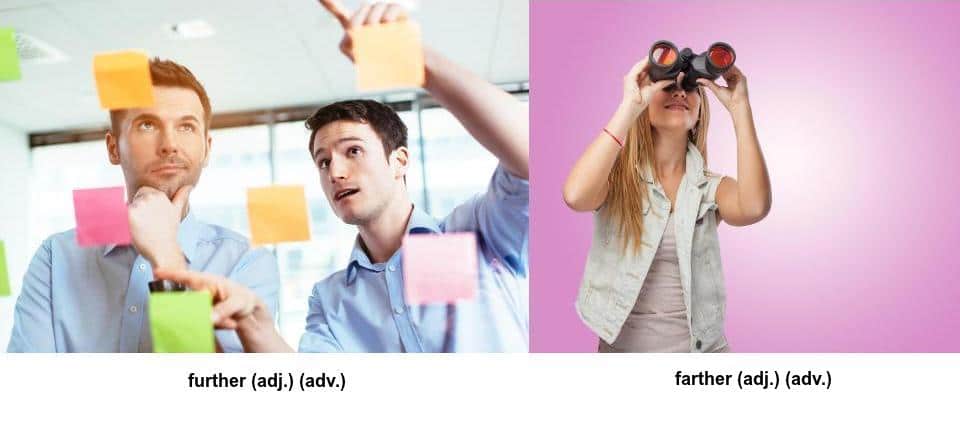
8. Further and Farther

These two are very confusing. Further and farther both have the same meaning but are used in different situations. They’re pronounced in a similar way too, but with a difference – fur and far.
9 english word pairs  that confuse absolutely everyone
Farther — with far — is used when we’re talking about physical distance.

  • As a passenger in a car, you can ask the driver “How much fartheruntil we reach our destination?”
  • In a race, you can say “She ran farther and faster than him.”
Further — with fur — is used for more abstract situations.

  • The human resources representative told me: “If you have any furthercomplaints, please tell me.”
  • The professor told us: “If you have any further questions you can ask me at the end.”
In those examples, complaints and questions are not physical things, so you cannot use the word farther. Take one more look at the difference between this two words in context:
If we drive any farther tonight we’ll be too tired to continue driving tomorrow.
We should discuss this topic further before we make a decision.


Read More

Friday, November 29, 2019

9 English Word Pairs That Confuse Absolutely Everyone - Part 7

 Heidi     November 29, 2019     Confusing Vocabulary   
7. Bear and Bare
9 english word pairs  that confuse absolutely everyone
Bear — as a verb — has several meanings, including to hold up or support a heavy weight and to suffer or endure difficulties. We’re not talking about big hairy bears that live in forests.

  • Don’t stand on that old chair, it cannot bear your weight.
  • I cannot bear to see my son in pain.
Bare, meanwhile, is an adjective that means naked or uncovered, or a verb which means to uncover or reveal.

  • Visitors to the temple must not have bare arms or legs, so wear long pants and a jacket (adjective).
  • I bared my arm to show them my new tattoo (verb).


Read More

Wednesday, November 27, 2019

9 English Word Pairs That Confuse Absolutely Everyone - Part 6

 Heidi     November 27, 2019     Confusing Vocabulary   
6. Disinterested and Uninterested

Many native speakers use these two words with the same meaning – bored, or not interested. That’s certainly the meaning of uninterested, but it’s not the meaning of disinterested. The real meaning ofdisinterested is impartial, objective or not taking a side in an argument.A judge hearing a court case should be disinterested, but definitely not uninterested!
9 english word pairs  that confuse absolutely everyone
  • The children wanted to play outside and were very uninterested in doing any studying.
  • Sometimes a stranger can make a disinterested and fair decision more easily than a family member.
These days, many people believe that disinterested can also mean uninterested. But it’s still helpful to know the difference.


Read More

Monday, November 25, 2019

9 English Word Pairs That Confuse Absolutely Everyone - Part 5

 Heidi     November 25, 2019     Confusing Vocabulary   
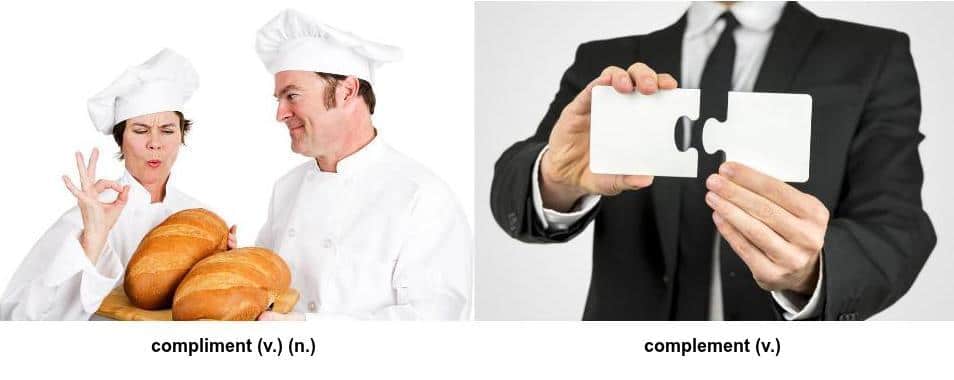
5. Compliment and Complement
9 english word pairs  that confuse absolutely everyone
Compliment — If someone says to you “I really like your shirt” then they’re complimenting you. In other words, they’re giving you a compliment. As a verb and noun, compliment means saying something nice about someone.
  • I complimented my sister on her delicious cooking (verb).
  • I gave my sister a compliment on her delicious cooking (noun).
Complement — is when two things go well together, or complete each other. This word is often used in food and in fashion to describe matching styles or ingredients.
  • My blue tie really complements my white shirt (my blue tie and white shirt go well together).
  • That wine complements the meat dish well.


Read More

Friday, November 22, 2019

9 English Word Pairs That Confuse Absolutely Everyone - Part 4

 Heidi     November 22, 2019     Confusing Vocabulary   
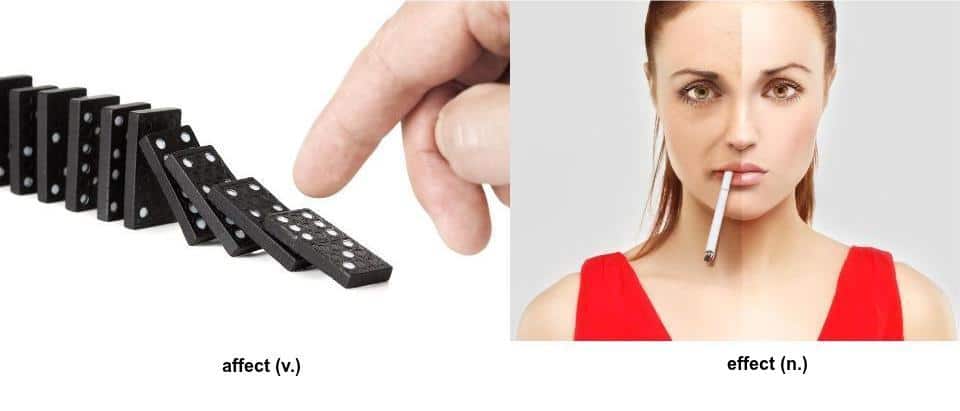
4. Affect and Effect

Again, with these two words the main difference is grammatical, although they’re pronounced slightly differently. Usually, affect is a verb and effectis a noun, and they’re used when talking about the results or consequences of particular actions.
9 english word pairs  that confuse absolutely everyone
  • I’m worried that your lazy habits will affect your studies (your lazy habits will have a bad effect on your studies).
  • Before you start an argument with your boss, consider the effects of your actions (before you start an argument, consider how your actions will affect the situation).


Read More
Older Posts → Home

Followers

About

Welcome to English at LERNFORUM Chur.  We teach English one to one or in small, personalised groups at every level and for every English language need. Cambridge and Swiss qualified, we're mother-language speaking, and most importantly, have a passion for helping you speak English.

Categories

  • builder (2)
  • Business English (46)
  • Cambridge Exams (42)
  • Canton School Preparation (68)
  • Confusing Vocabulary (132)
  • Design and Art (23)
  • Examinations: Examples & Tips (104)
  • First Certificate (3)
  • Grammar (237)
  • Just For Fun (259)
  • Level A1 (28)
  • Level A2 (29)
  • Level B1 (30)
  • Level B2 (24)
  • Listening & Multi-Media (147)
  • Pronunciation Practice (21)
  • Reading (168)
  • Speaking (29)
  • Vocabulary Building (240)
  • voice (2)
  • Word of the Month (26)
  • Writing (25)
  • you (1)
  • Young Learners (75)

Word of the Month

Holy

(adj): Sacred, divine, blessed.


Holiday: a holy or festive day; a day off, vacation (also sacred)


Expressions: Holy Cow! Literally true in India.

Ex: Holly Mackerel! Delicious, healthy and full of mercury.

Powered by Blogger.
Copyright © English at Lernforum Chur